


Before us is an exceptional piece of furniture – a tall mirror with a planter in the lower part, made of elaborately carved and richly gilded wood in a distinctive Neo-Rococo style, which was one of the revived styles of the past during the second half of the 19th century. The design of the mirror, its form and decoration were inspired by the Rococo style that was current in the 18th century and which came back into fashion in the second half 19th century, as one of the main sources of inspiration for designers and craftsmen from that period.
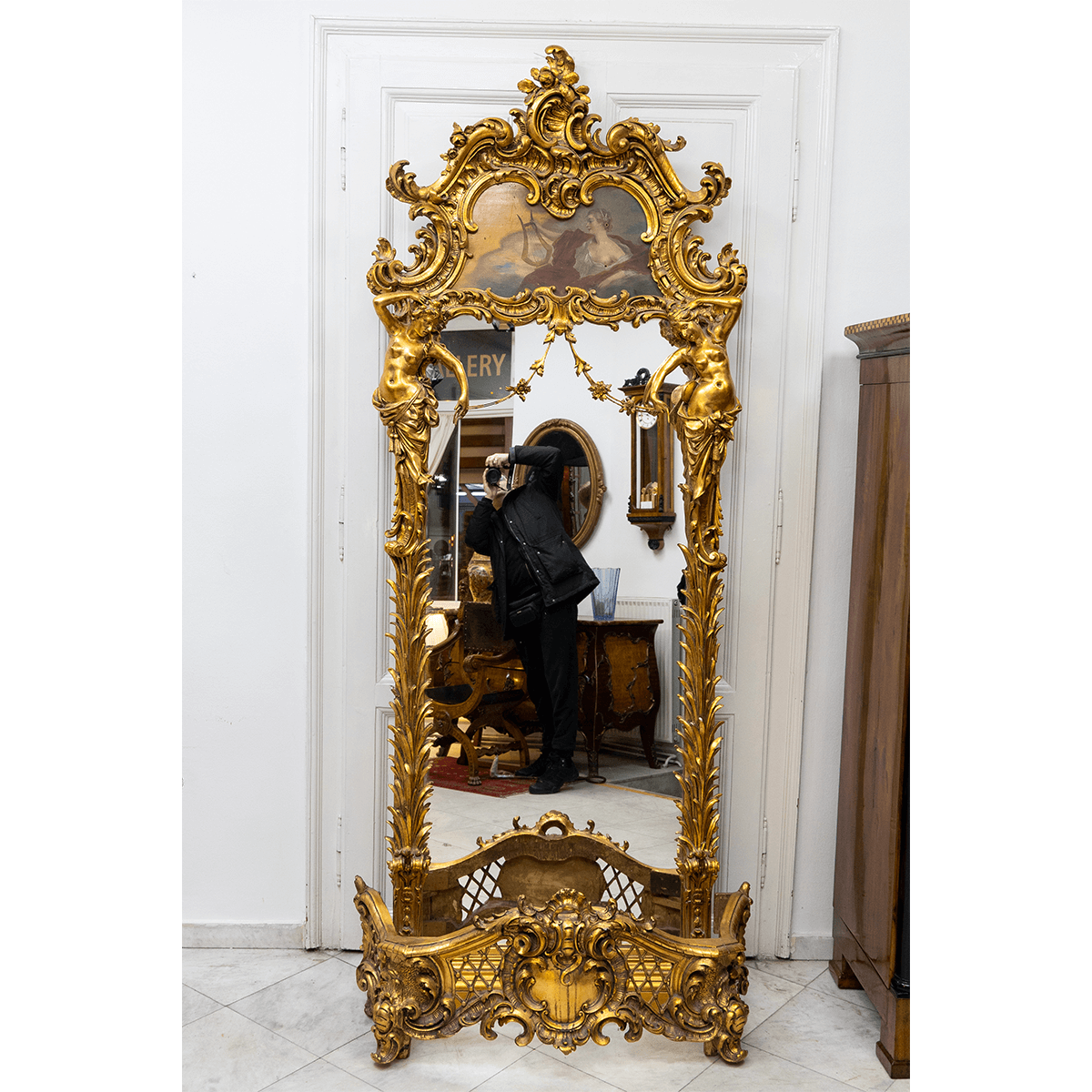


Mirror dimensions: mirror height: 270 cm, mirror width: 110 cm, planter height: 35 cm, planter width: 115 cm. Material: carved and gilded wood. Period: second half of the 19th century.
The vertically elongated slender mirror has sides that are shaped in the form of numerous slightly curved, thin leaves that occupy the lower two-thirds of the sides in a rich multitude. Above these flowing compositions are foliate volutes that transform into richly pleated draperies that wrap the lower part of the body of two female figures – caryatids emerging from the volutes. These female figures are inspired by classical antique art, have a bare torso, and one raised arm, bent at the elbow, as if supporting the upper part of a mirror. The upper part of the mirror is shaped in the form of a large cartouche (framed field) with a frame consisting of foliate volutes in the shape of the letter “S” and the letter “C” placed to form a very dynamic composition. The top of the mirror is modeled asymmetrically, which is one of the main characteristics of the Rococo style. The top consists of foliated “C” volutes combined with a typical rococo shell motif and a leafy branch with a rose motif. Inside the cartouche on the upper part of the mirror is an oil on panel painting.


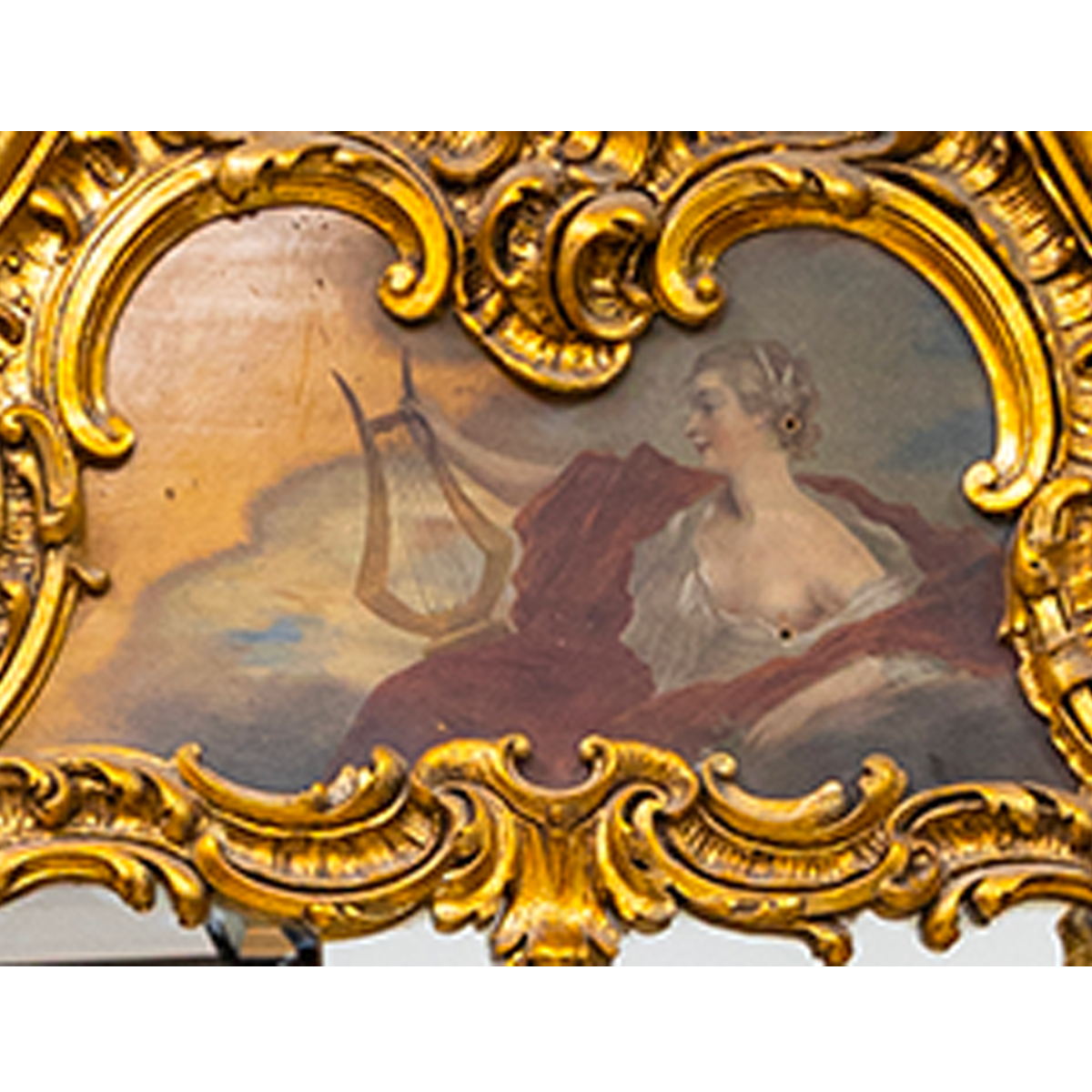
The picture shows a girl with bare breasts, her body partially covered with white and red drapery. The girl is stretched out on a cloud and in one hand she holds a musical instrument, a lyre. And while the lyre in ancient Greek mythology is primarily associated with the god Apollo, it can also be an attribute of certain muses, such as, for example, the muse of music and lyric poetry, Euterpe, or the muse of love poetry and mimicry, Erato. On the mirror itself, and on its upper part, there are two ropes each with flowers and leaves, which were also made by carving and gilding the wood. These ropes fall over the surface of the mirror in a semi-circular motion, while two caryatids on the sides of the mirror hold them with one hand.
The lower part of this fascinatingly luxurious piece of furniture is a planter, that is, a frame intended for a planter. Its corners and edges are formed by foliate volutes. The central part is arched and there is a cartouche surrounded by three foliate volutes in the shape of the letter “C”. Around the volute are typical rococo shell motifs. Above the cartouche is an elaborate ornamental composition consisting of foliate volutes and shells, with one asymmetric shell on top. In addition to the central cartouche, on the left and right sides there is a grid decoration formed by perforated rhombuses, inspired by lattices in garden wreaths. The planter has four low feet in the form of scrolls that are connected to the carved decorative composition of the entire lower part of the object.

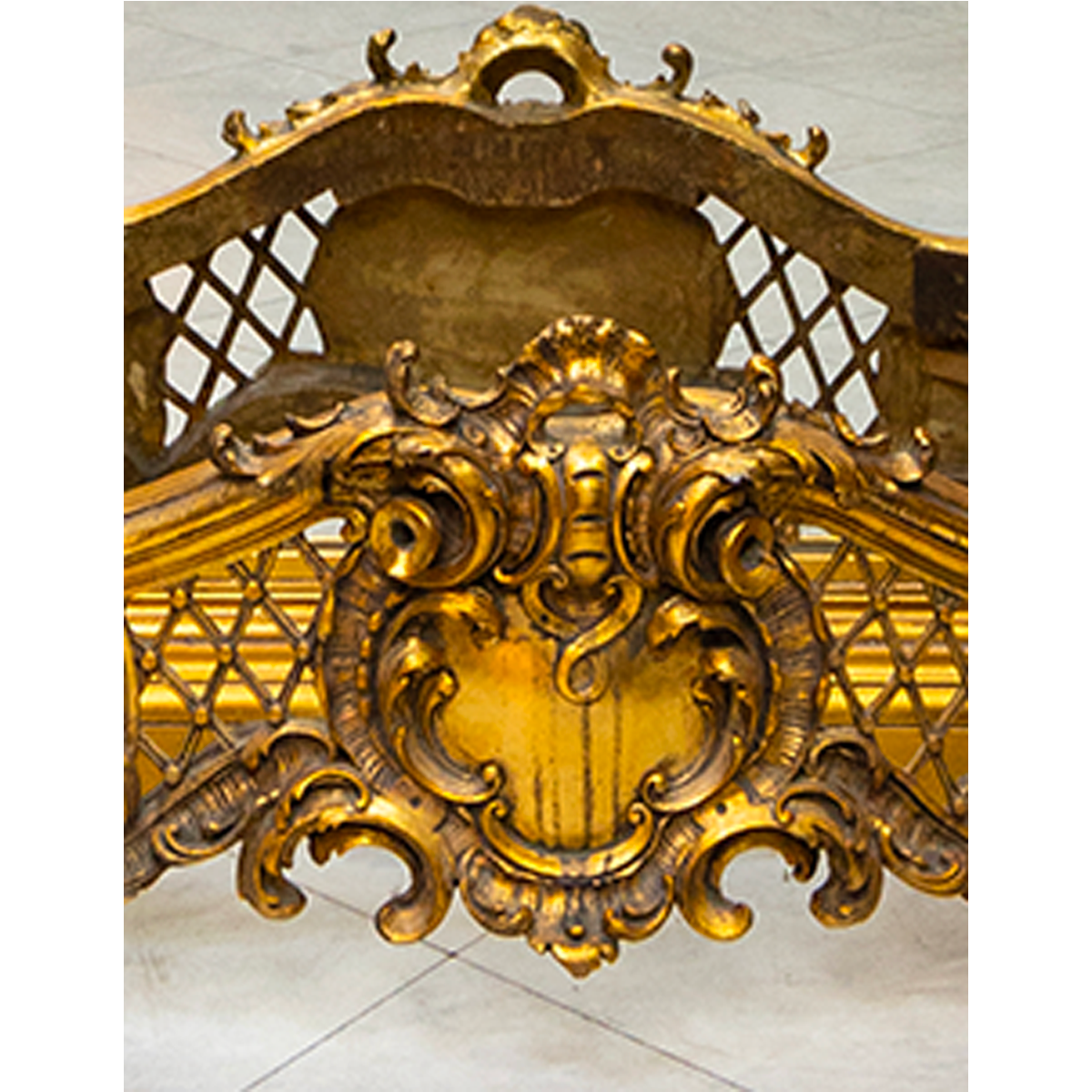

The gilding on the carved elements of the mirror and the planter is of extremely high quality and is made with real gold leaves. Gold has a warm glow characteristic of the shade known as “old gold”.
A tall mirror in combination with a planter is the type of mirror that was the most representative piece of furniture in the civil interior. That is why it was most often placed in the anteroom, at the entrance, with the intention of leaving a striking first impression upon entering the home, and to highlight the status and wealth of the host. This mirror certainly perfectly suited the representative role that was assigned to it. Very similar examples could be found in the homes of certain wealthy families in Novi Sad and Belgrade, but also in other cities in our area, especially on the coast, such as Dubrovnik or Kotor, where, as is known, the most luxurious furniture was ordered from Italy.
Neo-Rococo 19. century was a kind of international style, with a lack of distinctive regional characteristics. Therefore, this extraordinary mirror, made at the highest possible level of Zantastic craftsmanship, is difficult to attribute to a specific city or region. It is certain that it was created in one of the European centers, in one of the countries surrounding Vojvodina, in a workshop that hired highly professional artistic carpenters, carvers and goldsmiths.
The second half of the 19th century was a period when in Europe the revival of the styles of the past was in full swing, reaching its peak towards the end of the century. This trend was dictated by the wealthy bourgeoisie who wanted splendor, luxury, opulence and comfort in their interiors. The ideal style to fulfill these requirements was Rococo, which is among the most popular revived styles, so that in the 19th century, a variant of this style known as Neo-Rococo becomes current. The ornate and feminine Neo-Rococo style was recommended for the decoration of small reception rooms and bedrooms, but also for the production of particularly luxurious pieces of furniture that beautified other rooms in the home. Such is the case with this mirror with a planter, which was probably located in the entrance hall of the home of a wealthy family who zealously followed fashion trends in interior decoration.
Author: Melisa Niketić Graduated Academy of Art and Restoration “Palazzo Spinelli”, Florence, Italy, Department: Furniture Restoration and Antiquities Appraisal


